 1092e2f0f8
Was wave-1: CDN importmap, "schematic ring" NEOs, 13 gates. Now: vendored offline
Three.js, real NEO orbits, 22 gates, Epoch (deep-time) toggle, Sky-events layer +
event band, textured/tidally-locked/colourised moons, decade-century rates. Updated
intro, verify table, layer table, controls, architecture, credits.

Co-Authored-By: Claude Opus 4.8 <noreply@anthropic.com>
6.6 KiB
SOLARGOD ▸ Orrery
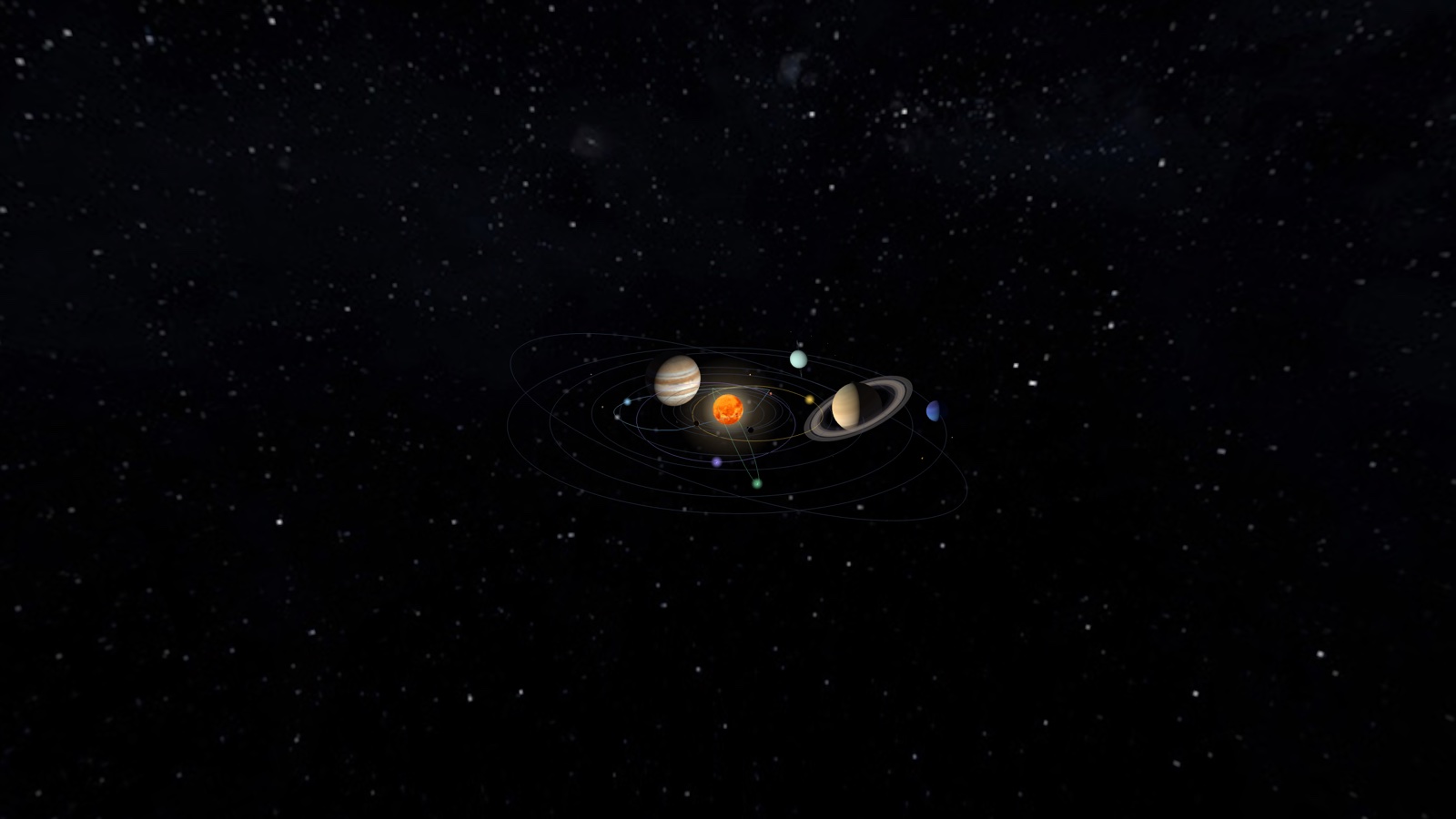
A standalone, browser-based 3D solar-system explorer — the interplanetary sibling of GODSIGH, which watches Earth. Float above a compressed-scale ("MEGA") solar system with every world visible at once, moving on real JPL ephemerides; scrub a time bar across six thousand years; fly the camera into orbit around any planet, its moons circling, textured and tidally locked; toggle TRUE scale and watch the system animate out into its real, humbling emptiness. Live layers plot where Voyager 1, JWST and Parker Solar Probe are right now, real main-belt asteroids, comets, and near-Earth close-approaches on their true orbits — and a computed almanac of oppositions and elongations on the time bar. Everything is client-side, free, keyless, and runs fully offline.
Quickstart
python3 serve.py          # stdlib only — no npm, no build step
# open http://127.0.0.1:8147
serve.py statically serves the app and proxies the JPL feeds a browser can't call
directly (Horizons / SBDB / CAD — no CORS), with a disk cache in cache/. Three.js
is vendored under vendor/three/, so the app runs with no CDN. The
deterministic core (Sun, planets, moons, orbits, sky events, time travel) runs with
zero network calls — positions are computed locally from Keplerian elements;
network layers (spacecraft, asteroids, comets, close-approaches) are additive and
fail soft.
Verify
Open http://127.0.0.1:8147/verify.html — an in-browser gate runner that checks the ephemeris against JPL Horizons ground truth (hard-coded checkpoints + live queries through the proxy). All 22 gates should read PASS, e.g.:
| Gate | Result |
|---|---|
| Mars / Jupiter / Earth @ 2026-07-15 (heliocentric ecliptic AU) | Δ ≤ 3.3e-4 / 2.9e-3 / 3.9e-5 AU |
| Kepler @ e=0.97 · orbitPath closes · frame round-trips · MEGA→TRUE keeps direction | exact |
| Mars @ J2000 · Jupiter @ 1900 vs live Horizons | Δ 4.8e-5 / 2.0e-3 AU |
| Main belt between Mars & Jupiter · Halley aphelion beyond Neptune | pass |
| Voyager 1 @ 2026-07-15 = (−32.07, −136.21, +98.55) AU · JWST hugs Earth | Δ 0.002 / 0.011 AU |
| NEO propagated miss vs CAD (real orbit) | ≤ 25% (median ~0.6%) |
| Sky events — Mars opposition ±2 d of 2027-02-19 · Venus elongation cadence · nextEvent | pass |
| Deep time — Jupiter @ 1000 BC · Mercury @ 2500 vs live Horizons (Table 2a/2b) | Δ 0.004 / 3.3e-5 AU |
| Event band maps the ±2 yr window to full width | pass |
Layers
| Layer | Source | Default | Notes |
|---|---|---|---|
| Planets & orbits | JPL SSD approximate elements (Standish) | on | 8 planets + Pluto, textured, MEGA-compressed orbit paths |
| Body labels | — | on | names; the focused body's children also get distance labels |
| Moons | NASA/USGS mosaics | on | 21 moons, per-parent compression, retrograde Triton; 8 with real surfaces, tidally locked; grayscale mosaics directorially tinted (Titan orange, Europa tan…) |
| Rings | true km, scaled to parent | on | Saturn (textured annulus) · Uranus (schematic) |
| Spacecraft | JPL Horizons (proxy) | on | Voyager 1/2, New Horizons, JWST, Parker, Juno, Lucy, Psyche — live distance + one-way light-time |
| Main belt | JPL SBDB (proxy) | off | ~1500 main-belt asteroids, shared Kepler core |
| Comets | JPL SBDB (proxy) | on | 1P/Halley, 2P/Encke, 67P, 96P — full orbits + anti-sunward 1/r² tail |
| Close approaches | JPL CAD + SBDB (proxy) | off | ±30-day NEOs at their true propagated positions with real orbits (per-object fail-soft to a schematic ring); miss distance in lunar distances |
| Sky events | computed (no network) | on | oppositions, conjunctions & greatest elongations as diamonds on the timeline's event band; click one to jump the clock |
Controls
- Focus — click any body (or use the Focus menu) → the camera flies into orbit
around it; breadcrumb
SOL ▸ JUPITER ▸ EUROPA;Escsteps out one level. - MEGA / TRUE — toggle the scale mode; the transition animates over ~2.5 s.
- Epoch —
1800–2050/3000 BC – 3000 AD: switch to the extended Table 2a/2b range (reloads the session, carried in the hash as&e=1). - Body scale — 1× / 100× / 1200× radius exaggeration.
- Time bar — NOW, play/pause, reverse, rate presets (
1× · 1 min/s … 1 yr/s, plus1 decade/s · 1 century/sfor deep time), a scrubbable timeline, and an event band below it mapping the computed ±2 yr window to full width (a bracket on the main strip marks its extent). A LIVE / SCRUBBED chip mirrors GODSIGH. - Info panel — appears on focus: a grimoire card with a physical fact sheet, hand-written prose, a stylized portrait, and live computed facts (distance from Sun & Earth, sunlight age, orbital speed, day & year length, and the next opposition/elongation). Focusing Earth reveals a link to the GODSIGH world view.
- Shareable URLs — the view serializes to the hash
(
#f=<body>&t=<time>&s=<mega|true>&L=<layers>&cam=…&e=<0|1>); paste one to reproduce a view. ?debug=1— frame-rate / scale readout.
Architecture
No build step, no framework, plain ES modules; Three.js vendored offline. One
module owns the truth→view transform (scale.js); every position is computed in
real heliocentric J2000 ecliptic AU first (ephem.js) then compressed. A
floating origin subtracts the focused body's position in float64 before writing
to the scene graph, so a focused planet never jitters at close zoom.
index.html · serve.py · verify.html
css/style.css · vendor/three/ (vendored, MIT)
js/  config lib ephem bodies scale ui main
js/layers/  planets moons rings spacecraft asteroids comets neos events almanac
assets/textures/ (CC BY + NASA/USGS public domain)  ·  assets/art/grimoire/ (generated)
The full execution spec is SOLARGOD_BRIEF.md; wave-2 polish is PERIHELION_BRIEF.md.
Credits
- Positions — JPL SSD approximate elements; live feeds via JPL Horizons / SBDB / CAD.
- Planet/Sun/ring/sky textures — Solar System Scope, CC BY 4.0.
- Moon surfaces — NASA/USGS Astrogeology mosaics (public domain); grayscale ones
directorially colour-tinted. See
assets/textures/CREDITS.md. - Grimoire art — generated locally with MODELBEAST / FLUX (see
assets/art/PROMPTS.md); the aesthetic layer only — real worlds get real data. - Built on Three.js (r170, vendored, MIT).